“This post is written directly by the head physician of Lucenne Clinic, not by a marketing agency employee, reflecting genuine concerns from the consultation room.”
A few days ago, a working professional visited our Lucenne Clinic near Exit 3 of Sinnonhyeon Station.
She was a marketing team employee in her late 30s working at a major corporation.
“Doctor, I sit all day at work. From 9 AM to 7 PM, I barely get up from my desk. Lately, when I look in the mirror, my jawline seems to be disappearing. It’s not quite a double chin… but my face looks saggy somehow?”
As she traced her jawline with her hand, I sensed not just dissatisfaction with her appearance, but genuine confusion and anxiety about how her face was changing.
Along Gangnam-daero, high-rise buildings line the street. How many people inside those buildings are sitting in front of computers at this very moment?
The Reality of Office Workers: Among the World’s Longest Sitters
This patient’s concern is deeply connected to Korea’s social structure.
According to OECD data released in 2024, Koreans work an average of 1,865 hours annually—nearly 130 hours more than the OECD average of 1,736 hours.
Moreover, over 80% of Korean workers are classified as office or administrative workers, meaning they spend most of their day sitting.
Statistics Korea data is even more striking: office workers in Korea sit for an average of 8.3 hours per day, with this figure exceeding 10 hours in IT, finance, and consulting sectors. This represents a steady increase from 7.5 hours in 2014.
How does this sedentary lifestyle affect our bodies?
Research from Seoul National University Hospital’s orthopedic surgery team shows that prolonged sitting causes the neck to adopt a forward-bent posture. This posture applies continuous pressure to the fat layer beneath the chin, promoting fat cell proliferation.
The study found that people who sit for more than 8 hours daily have submental fat layers that are 2.3mm thicker on average compared to those who don’t. While 2mm may seem small, it’s the critical difference that determines jawline definition.

The Patient’s Jawline Condition
I conducted an AI skin diagnosis and ultrasound examination on the patient. At Lucenne Clinic, we always perform scientific diagnostics before any lifting procedure because what we see externally differs from the actual structure beneath the skin.
The ultrasound revealed that the patient’s submental fat layer measured approximately 9.8mm thick—slightly thicker than the standard 7-8mm average for Korean adult women.
Additionally, the lower dermal layer showed laxity, with blurred boundaries between fat and skin. This indicated simultaneous progression of reduced skin elasticity and fat accumulation.
“It’s not quite a double chin yet, but fat is gradually accumulating, blurring your jawline. Your skin elasticity is also declining, so if we only remove fat, your skin might actually appear more saggy.”
The patient nodded. “So… what should I do?”
Why I Recommended ONDA Lifting
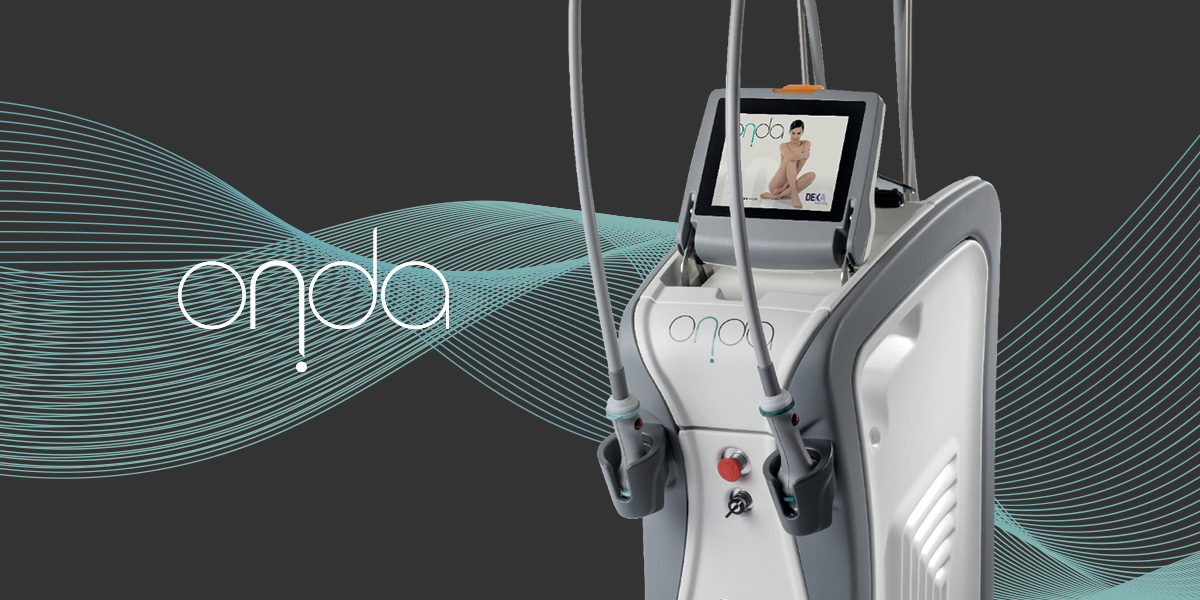
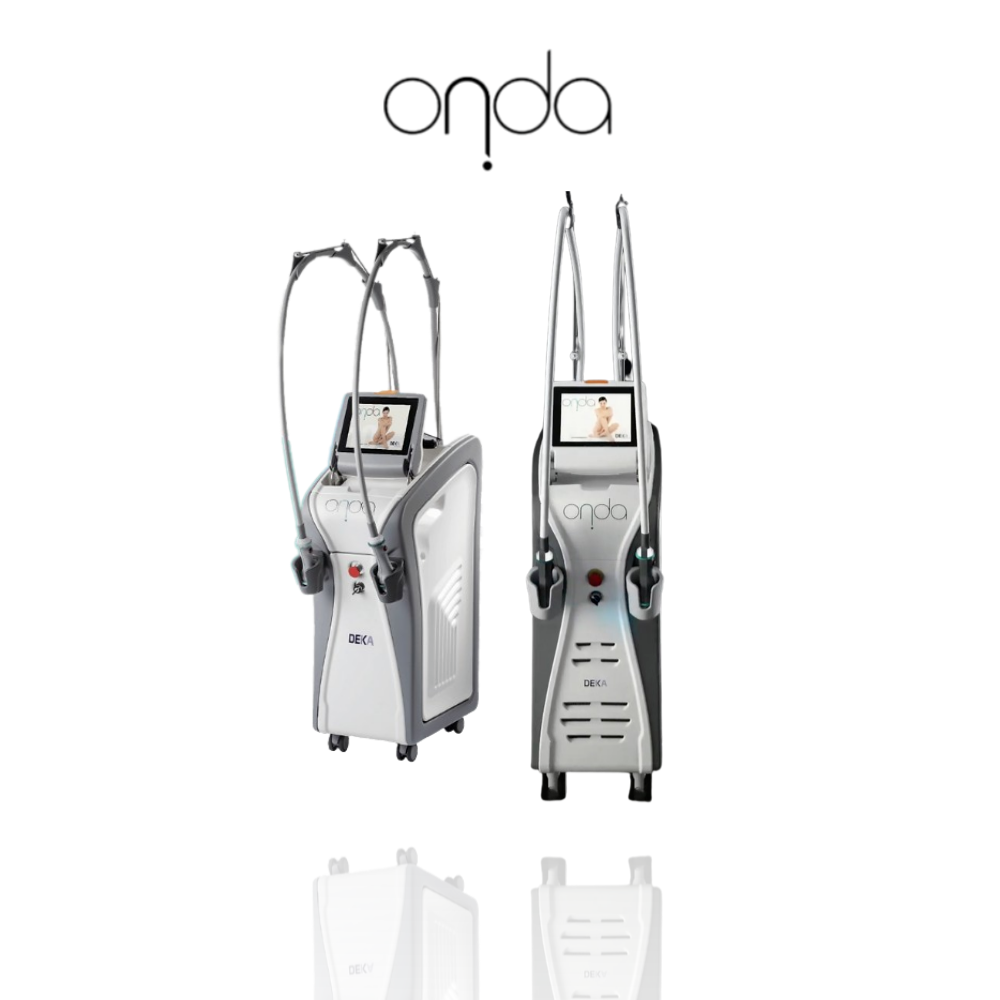
I suggested ONDA lifting for clear reasons:
- Simultaneously addresses fat reduction + skin tightening
- Virtually no pain or downtime, allowing normal daily activities
- No bruising or swelling—the main concerns for working professionals
ONDA Lifting: What Makes It Different?
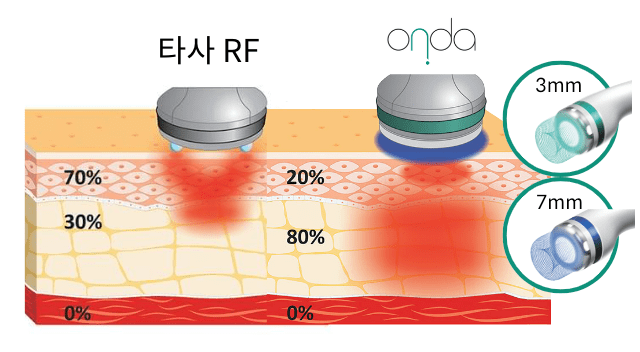
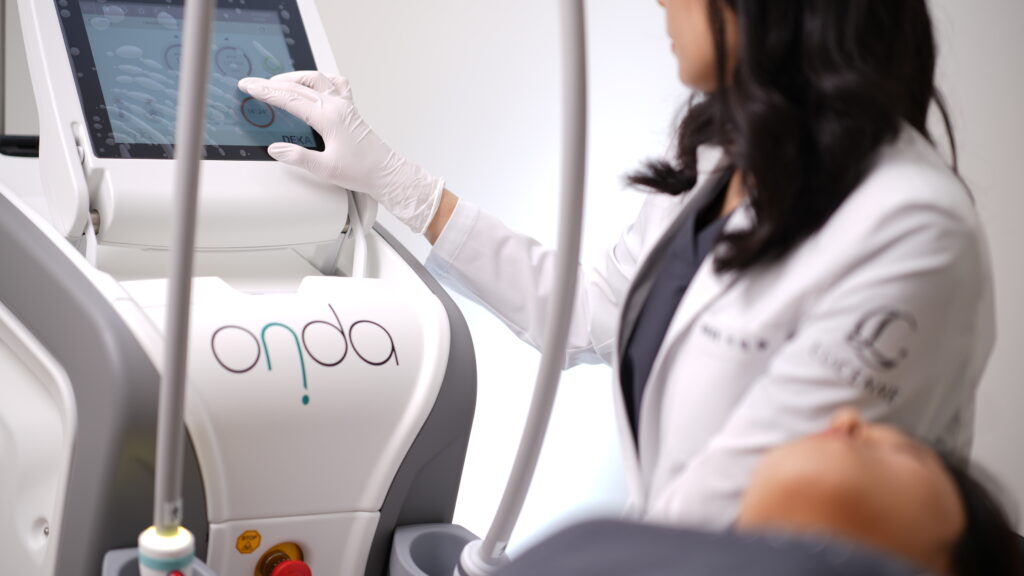
The core of ONDA lifting is microwave technology. It operates on completely different physical principles from commonly known radiofrequency (RF) or high-intensity focused ultrasound (HIFU).
The 2.45GHz microwave band passes through the skin surface almost “transparently.” Like light passing through a glass window, it travels through the epidermis and upper dermis with virtually no energy loss. When it reaches the subcutaneous fat layer, it begins releasing energy.
Why? Fat tissue has low conductivity and high dielectric constant, giving it strong microwave-absorbing properties. Simply put, the fat layer acts as a “container” that traps microwaves.
The Mechanism of Fat Cell Destruction: The Secret of 50℃
When microwaves are absorbed into the fat layer, water molecules and fat molecules inside fat cells rotate 2.4 billion times per second. This rotation generates frictional heat, raising the fat layer temperature to 50-55℃.
Why is this temperature important? Laboratory studies show that when fat cells are exposed to 50℃ for one minute, their survival rate drops dramatically from 89% to 20%. Unable to withstand structural stress, cell membranes rupture, causing fat cells to enter “programmed cell death.”
These damaged fat cells are naturally broken down by macrophages and eliminated from the body. Importantly, fat cells don’t just shrink—the number of cells itself decreases. That’s why the effects last so long.
“Should We Do 40,000 Shots or 60,000 Shots?”
After explaining ONDA lifting, the patient asked her next question:
“Doctor, I searched online and different clinics use different shot counts. Some say 40,000 shots are sufficient, others say you need 60,000 or more… what’s the difference?”
This is a crucial question. My answer: Neither “60,000 shots are always better” nor “40,000 shots are never enough” is accurate.
When Are 40,000 Shots (40,000 Joules) Meaningful?
40,000 shots, or 40kJ (kilojoules) of energy, delivers meaningful results in these cases:
- Mild cases: Jawline is slightly blurred but no prominent double chin
- Skin elasticity focus: Main goal is tightening loose skin rather than removing fat
- Introduction or maintenance: First-time ONDA experience or maintenance after previous 60kJ treatment
Research from Yonsei University College of Medicine’s dermatology team shows that 40kJ raises tissue temperature to 42-45℃. This temperature sufficiently induces neocollagenesis but falls somewhat short of the 50℃ threshold for complete fat cell destruction.
In other words, 40kJ excels at “firming and tightening skin” but has limited effectiveness in “reducing fat volume itself.”
60,000 Shots (60,000 Joules) or More: Why Recommended?
Conversely, 60kJ or more creates a decisive difference by crossing the fat cell destruction threshold:
- Complete fat cell destruction: Sufficient exposure to 50℃+ causes irreversible cell damage
- Volume reduction: Considering the average Korean submental fat thickness (8-12mm), 60kJ reduces this by 20-30%
- Long-term durability: Destroyed fat cells don’t regenerate, making effects semi-permanent
A 6-month follow-up study of 120 patients at a domestic university hospital dermatology department showed:
- 60kJ group: 28.5% fat thickness reduction, 87% patient satisfaction
- 40kJ group: 14.2% fat thickness reduction, 63% patient satisfaction
More interestingly, the 60kJ group showed continuous improvement even after the first treatment, while the 40kJ group’s effects plateaued after 3 months.
Lucenne Clinic’s Choice: Ultrasound-Based Customized Design
That’s why Lucenne doesn’t insist on “always 60,000 shots.” Instead, we follow this process:
- Precise ultrasound diagnosis: Layer-by-layer measurement of fat thickness, skin elasticity, muscle condition
- Energy calculation: Calculate required energy based on patient’s fat thickness (physics-based formula)
- Handpiece distribution: Design the ratio of 7mm (Deep) and 3mm (Shallow) handpieces
For this patient, with 9.8mm fat thickness and reduced elasticity, I recommended the 60,000-shot protocol:
- 7mm handpiece (40,000 shots): Targeting central chin and deep submental fat layer
- 3mm handpiece (20,000 shots): Jawline border and lateral skin tightening
Immediately After Treatment: The Patient’s Reaction
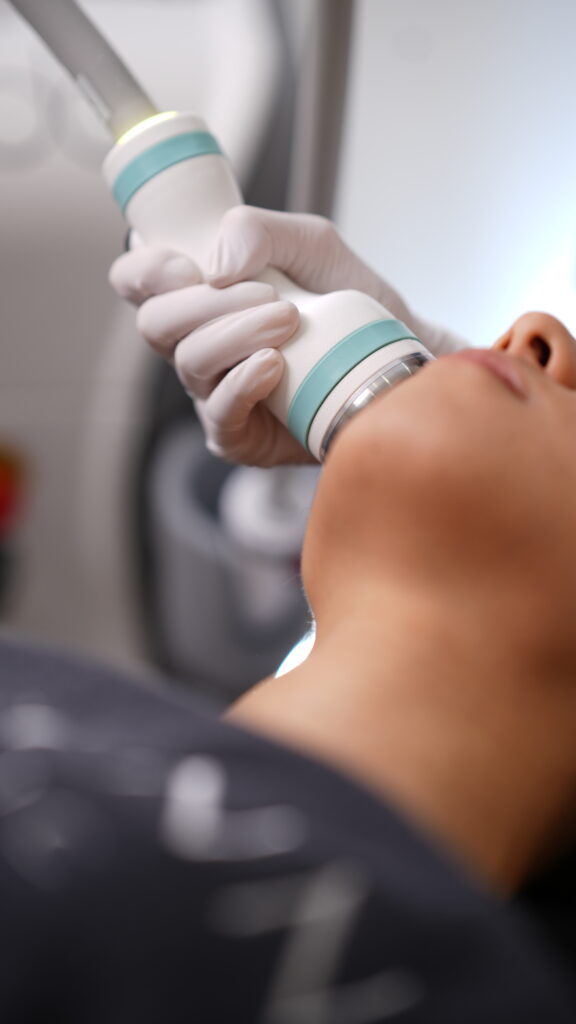
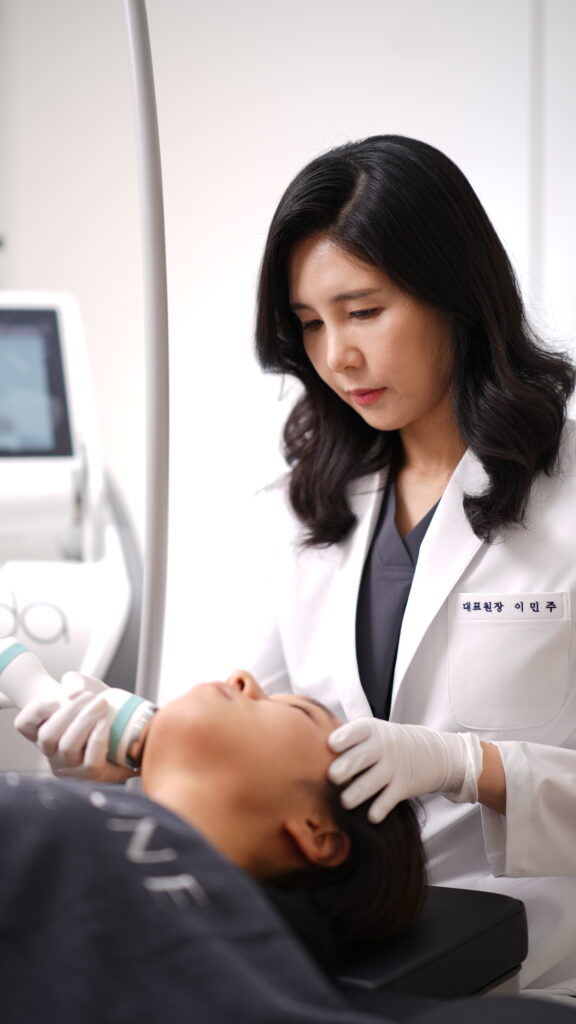
The procedure took about 30 minutes. The patient proceeded without numbing cream and said, “It feels like a warm massage. It doesn’t hurt at all!”
Right after treatment, I showed her a mirror.
“Already? My jawline… looks more defined!”
Yes, one of ONDA lifting’s characteristics is immediate tightening effect. Because microwaves instantly contract collagen fibers in the dermis, you can feel skin tightening right after the procedure.
Of course, the real transformation begins 2-3 weeks later. As damaged fat cells are broken down by macrophages and new collagen forms, the jawline becomes progressively sharper.
The patient returned to daily life with no bruising or swelling. “I’ll come back. You said 3 sessions at 3-week intervals, right?” Her bright expression as she left remains memorable.
Compared to Other Treatments?
Patients frequently ask in the consultation room: “How is this different from InMode?” “Can’t I get Ultherapy?”
Difference from InMode FX
InMode uses radiofrequency (RF) for fat reduction. It vacuum-suctions the skin, then passes high-voltage current through it to burn fat.
- Advantages: Powerful fat removal, relatively affordable
- Disadvantages: Physical suction inevitably causes petechiae (bruising), with stinging pain when current flows. Requires 5-7 days downtime.
In contrast, ONDA involves no physical impact or suction. Energy penetrates skin to act only on the fat layer, achieving the same results without bruising or pain.
Difference from Ultherapy
Ultherapy uses high-intensity focused ultrasound (HIFU) to target the SMAS fascial layer.
- Advantages: Powerful lifting effect, excellent for pulling up sagging skin
- Disadvantages: Extremely painful (8-9/10), limited fat removal
ONDA is optimized for fat reduction + tightening rather than lifting. Rather than “pulling skin upward,” it works by “melting fat and tightening skin.”
| Comparison | ONDA | InMode FX | Ultherapy |
|---|---|---|---|
| Core Technology | Microwave | RF + High Voltage | HIFU (Ultrasound) |
| Target Layer | Fat + Dermis | Fat Layer | SMAS Fascia |
| Main Effect | Fat Reduction + Elasticity | Powerful Fat Removal | Powerful Lifting |
| Pain Level | 1-2/10 (minimal) | 5-7/10 (moderate-high) | 8-9/10 (extreme) |
| Downtime | None | Bruising, swelling 5-7 days | Mild swelling |
| Recommended Cycle | 3 sessions, 3-4 weeks apart | 3 sessions, 2-4 weeks apart | 6 months-1 year apart |
Are There Side Effects? Let Me Be Honest
One of Lucenne Clinic’s philosophies is “honesty.” We don’t just talk about benefits—we transparently share potential side effects.
ONDA Lifting Side Effects
- Heat sensation and temporary redness: Skin may redden slightly immediately after treatment, but the built-in cooling system resolves this within 1-2 hours
- Temporary lumps: Rarely, subcutaneous tissue may feel firm during fat breakdown. This signals active fat decomposition and resolves naturally within weeks
- Nerve stimulation: The marginal mandibular nerve runs beneath the chin. Excessive heat near this nerve can rarely cause temporary lip movement sluggishness. This isn’t permanent damage and recovers naturally within weeks
Lucenne’s Safety Protocol
We operate these safeguards to minimize side effects:
- Ultrasound mapping: Identify nerve and blood vessel pathways before treatment to avoid danger zones
- Moving technique: Continuously move the handpiece without stopping in one place to prevent excessive heat accumulation
- Real-time temperature monitoring: Check skin surface temperature in real-time and adjust immediately if exceeding safe ranges
Recommended For (And Not Recommended For)
ONDA Lifting Strongly Recommended For:
- Fat-type faces: Buried jawline with prominent double chin
- Pain-phobic individuals: Can’t tolerate painful procedures but want definite results
- Busy professionals: Important schedules ahead where bruising or marks would be problematic
- Multiple concerns: Want fat removal and improved skin elasticity simultaneously
ONDA Lifting Not Recommended For:
- Thin skin without fat: Minimal facial fat with paper-thin skin (Ultherapy or Thermage may be more suitable)
- Severe muscle-type square jaw: Jaw enlargement caused by muscle (masseter) rather than fat (Botox should be prioritized)
- Surgical-level expectations: Expecting dramatic physical pulling at surgical facelift level (thread lifting or surgery should be considered)
In Closing: Scientific Evidence and Honest Practice
The patient’s final words as she left the consultation room remain with me:
“Doctor, I’ve visited several clinics for consultations. Lucenne feels different somehow. You showed me the ultrasound directly and explained scientifically why 60,000 shots are needed. That builds trust.”
ONDA lifting isn’t simply rubbing a machine on skin. The physician’s competence in comprehensively considering the patient’s fat thickness, skin elasticity, and lifestyle patterns to deliver the necessary energy at the precise depth makes the difference in results.
Neither 40,000 shots being inherently insufficient nor 60,000 shots being inherently better is true. What matters is “for whom, for what purpose, in what condition” it’s used.
Based on scientific evidence and honest practice philosophy, Lucenne Clinic accompanies you on the journey to find your inherently beautiful contours.
We await you at Lucenne Clinic, Exit 3 of Sinnonhyeon Station.